
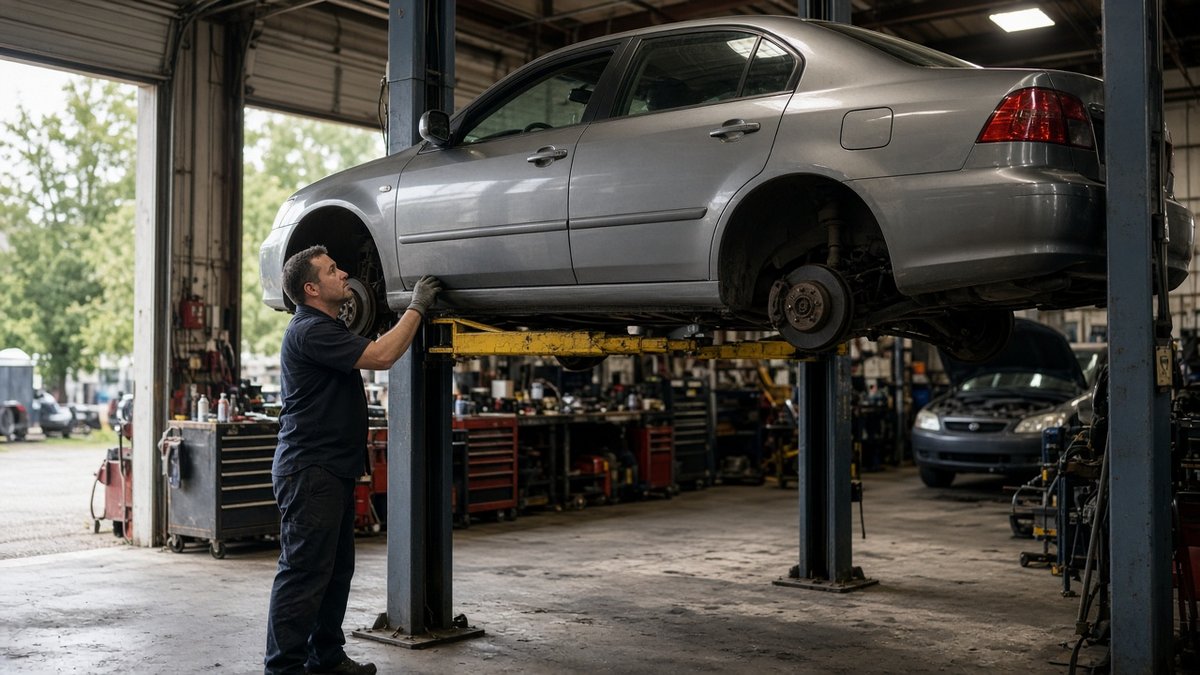
CARFAX shows a starter replacement only when the shop that swapped it reports service records, so on plenty of cars the job happened and the report says nothing. When a row does appear, you get a date and mileage, and that's handy for one thing in particular: spotting a car that keeps eating starters, which usually points at a wiring, battery, or flood problem rather than bad luck.
We're putting this together in early October 2026, after a run of posts on battery replacement records and alternator replacement records, and the starter sits right between those two. All three can leave a car dead in a parking lot, and shops misdiagnose them for each other all the time. So a starter row on a history report is worth reading together with any battery or charging work around the same mileage, not on its own.
How a starter job lands on the report
A starter replacement reaches CARFAX through the same service-record feed that carries oil changes and brake jobs. The CARFAX vehicle history report page lists service history as its own section next to accidents, title brands, and odometer readings. Dealers and big chain shops that share data often send a line with the date, the mileage, and a short note. An independent shop that doesn't report, or an owner who bolted in a parts-store starter in the driveway, leaves no trace at all. Starters on a lot of older trucks and sedans are a two-bolt job, so the driveway version is common.
The wording varies a lot too. We've seen this kind of work logged as "starter replaced," "starter motor serviced," "electrical system checked," or folded into a vague "vehicle serviced" entry. So if you search the report for the word starter and come up empty, read every service row that mentions electrical, battery, or no-start diagnosis. Our guide to what CARFAX shows about mechanical problems explains why repair history gets reported so unevenly.
What a starter row actually tells you
One starter replacement at high mileage is normal wear and honestly not worth worrying about. Starters have brushes, a solenoid, and a drive gear that all wear out, and a car past 100,000 miles on its original starter is living on borrowed time anyway. A fresh starter at that point is a mild plus. The row gets interesting when it shows up twice, or early. Two starters inside 30,000 miles is a pattern, and the usual suspects are a weak battery or corroded cables making the starter work too hard, a bad ground, or heat from a leaking exhaust cooking it.
Water is the other big one. Starters sit low on many engines, and a car that's been through deep water often shows electrical gremlins months later. If you see a starter replaced alongside a battery, alternator, or wiring work in a short window, and the car came from a hurricane or flood region, read our post on starter motor corrosion and flood damage before you go any further. Flood cars get retitled across state lines, and a cluster of electrical repairs is sometimes the only clue left.
Cost, and why the row can save you money
A starter job isn't cheap, which is why a seller's "just needs a starter" line deserves suspicion. Kelley Blue Book lists an average starter replacement cost of about $728 to $820, and that swings a lot by vehicle, since some V6 and V8 engines bury the starter under the intake manifold. AAA's breakdown of starter replacement cost also warns you to rule out the battery and alternator first, because a no-start isn't automatically a starter. So if a seller says the car only needs a starter and knocks a couple hundred off, you may be buying a much bigger electrical problem at a discount that doesn't cover it.
Checking the history first is cheap by comparison. Retail CARFAX reports usually run somewhere around $39.99 to $44.99, and sources still disagree on the exact number, while we sell licensed CARFAX and AutoCheck reports for roughly $5.50 as a guest or $4.50 as a member, with a bundle around $6.75. Prices move, so confirm at checkout. We're a reseller and aren't affiliated with CARFAX, AutoCheck, or Experian.
How to check the starter yourself
Since the report often can't answer the question, test the car cold. Ask the seller not to start it before you arrive, then turn the key and listen. A single loud click with bright dash lights, grinding, a slow crank with a strong battery, or a starter that keeps whirring after the engine fires are all the warning signs AAA lists. Rapid clicking with dim lights points more toward the battery or cables. Start it a few more times once it's warm, because a failing starter often acts up hot. If anything seems off, a shop can bench-test the starter or run a voltage-drop test, and the AA1Car guide to diagnosing starter and alternator problems explains why a quick jump test doesn't prove much.
Traps we keep seeing
The worst trap is the seller who hands you a printed report and won't let you pull your own. Edited PDFs are easy to fake, and adding a tidy "starter replaced" row takes minutes, so read how to spot a fake CARFAX report before you trust paper. The second is the jump-start demo, where the seller has the car already running when you show up. That hides a dead starter and a dead battery equally well. The third is mileage, since a starter row logged at a higher odometer reading than the listing shows means something doesn't add up.
So treat the starter line as a clue. Use the report to catch repeat electrical work or a mileage mismatch, then let a cold start and a mechanic's test settle the rest.
Comments (0)
No comments yet. Be the first to share your thoughts!
Log in to leave a comment.