
The cluster says 61,000. The brake pedal says the car has been driven by someone who treats pedals as a hobby. Believe the pedal until the paper catches up.
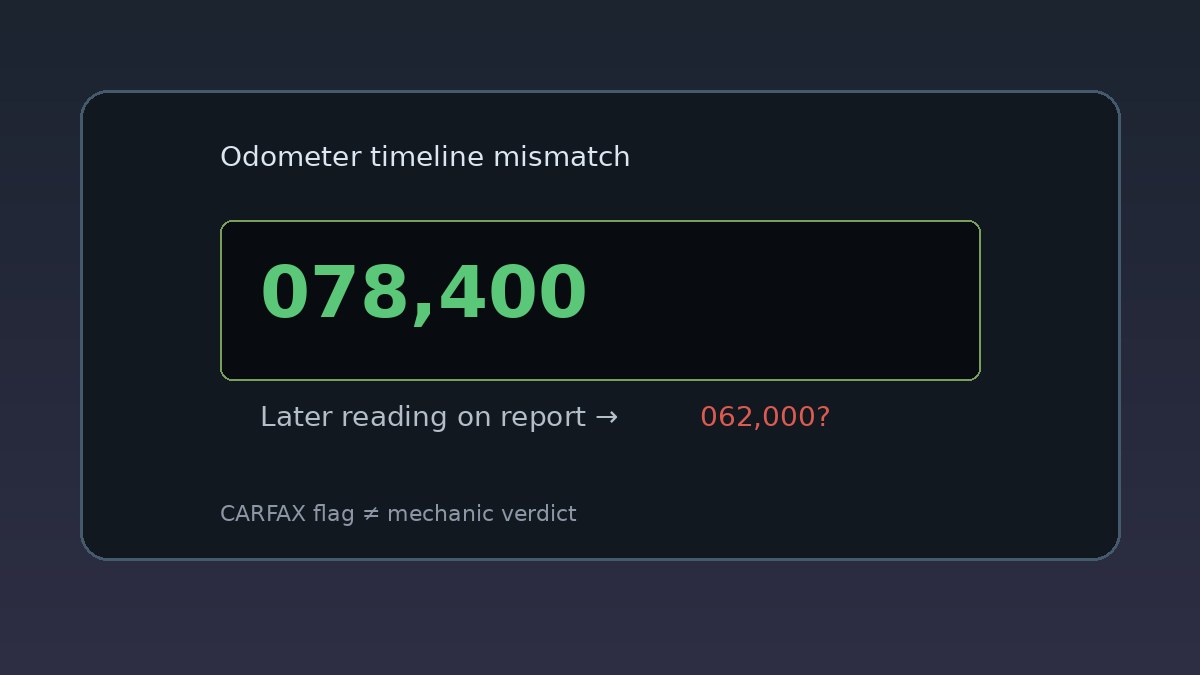
Odometer rollback is old fraud with a newer toolbox. Mechanical clusters got a drill. Digital clusters get a laptop. Late September 2026, both still show up in private-party ads, and a clean CARFAX is not a lab test of the chip. CARFAX only prints mileage events that somebody reported. Gaps are normal. A reading that goes down is not.
Retail CARFAX often lands between about $39.99 and $44.99. Confirm. Here, guest is about $5.50, member about $4.50, bundle about $6.75, credits from around $3. Confirm at checkout. Skipping the report to “trust the seller’s photo of the cluster” is how you buy a story. Blunt risk — that photo is also the easiest fake PDF cousin: a cropped screenshot. Verify the file.
What the report is allowed to flag
Read the mileage table, not the headline. You want dates and numbers in order.
- A later reading lower than an earlier one, with no title explanation.
- “Not actual mileage,” “exceeds mechanical limits,” or an odometer brand on the title. Those are legal words, not vibes. Exceeds mechanical limits.
- A long gap, then a sudden young number right before a sale.
- Auction mileage and retail mileage that don’t share a century.
- Title brands and state jumps in the same season as the mileage miracle. Odometer discrepancy on CARFAX.
Here’s the catch. A missing oil-change reading is not rollback. Indie shops often never report. A number that decreases is the row you stop for. So don’t yell “fraud” at a thin service list. Yell it at arithmetic.
Physical checks that don’t need a dealer login
Look at wear like a pessimist.
- Pedal rubber, seat bolster, steering wheel shine versus the claimed miles.
- Service stickers on the door and windshield. Dates and mileage that outrun the cluster.
- Oil-change invoices the seller actually possesses, not “I do it myself” with zero bottles in the story.
- Belt, tires, and brake feel. New tires on a “low mile” car can be honest. New tires plus a shiny cluster plus a trashed interior is a costume.
We’ve seen clusters swapped after a wreck, which makes the number low without a classic “rollback” headline. The history shows an accident or an airbag, the miles look shy, and the seller calls it garaged. Accident reported still matters when the odometer looks cute.
A shop with a scan tool can sometimes see module mileage that doesn’t match the cluster. That’s a pre-purchase inspection job, not a phone photo. PPI versus the report.
Title, NMVTIS, and the honest limit
Federal odometer disclosures live on titles. NMVTIS is built to carry the latest title odometer among other brand data. It will not catch a rollback that happened last week and hasn’t been titled yet. AutoCheck sometimes shows auction mileage CARFAX doesn’t. If the car smells like a lane car, pull both or at least the one that sees auctions. What each report catches.
Honestly, you will not prove every digital rollback in a driveway. You can refuse cars where the paper falls, the wear screams, or the seller won’t allow a scan. That’s enough.
Licensed reseller of official reports. Not affiliated with CARFAX, AutoCheck, or Experian. We can’t “clear” a mileage brand because you want the payment to be smaller.
If the numbers go backward, walk or price it like a branded odometer. Cute miles are the expensive kind.
Digital clusters and the honest ceiling
A shop that knows the car can look for mileage stored in modules that didn’t get overwritten with the cluster. Not every independent garage will do it, and not every car stores a useful second number. Ask before you book the PPI so you are not paying for a test drive with a flashlight.
Title brands that say the mileage is not actual are a disclosure, not a suggestion. You can still buy the car. You price it as a car whose miles are a rumor, and you assume the next buyer will do the same. Lenders get shy. We’ve seen credit unions shrug at a pretty SUV the moment “not actual” showed up on the title app.
Don’t accuse a stranger of a federal crime in the driveway because the seat looks tired. Say the wear and the records don’t match, and leave. Accusations without the falling number are how meetups get dumb. The falling number, or a brand, is when you get specific.
Service records that jump in a sane direction — 40k, then 52k, then 61k — are the pattern you want. What service lines actually prove. A single high reading at auction and a low reading at retail is the pattern you photograph and walk away from.


Comments (0)
No comments yet. Be the first to share your thoughts!
Log in to leave a comment.