
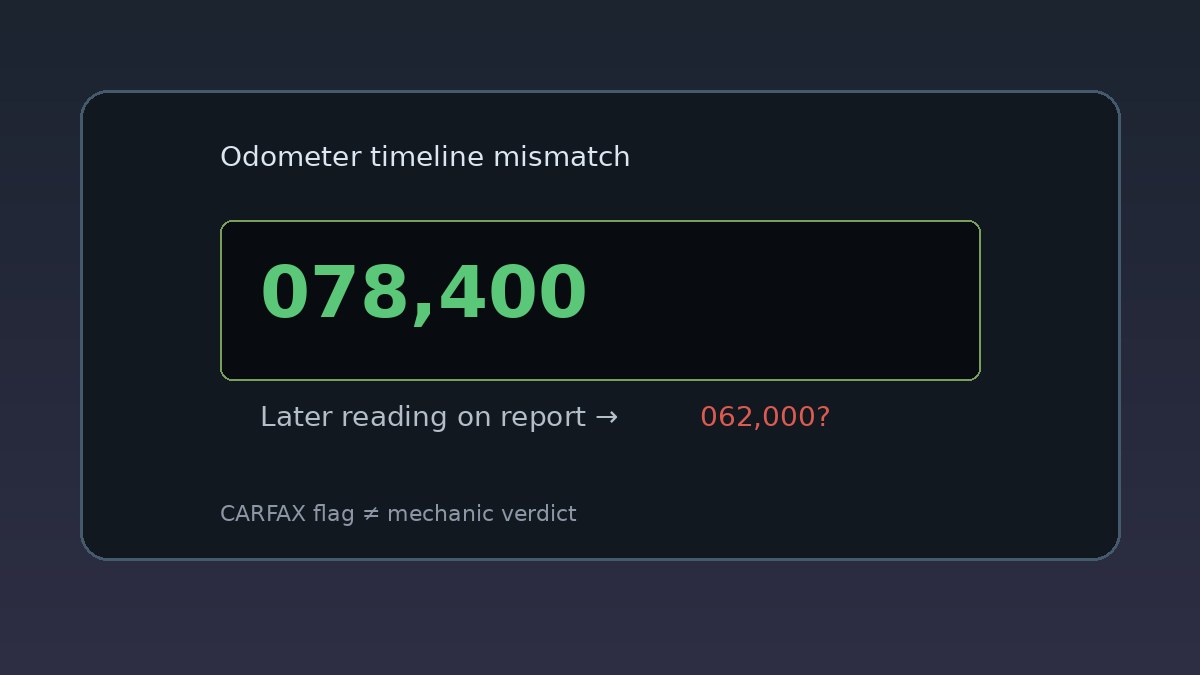
You’re staring at a listing that says 62,000 miles. The CARFAX timeline shows 78,400 three years ago. That gap isn’t a typo you shrug off — it’s the report telling you the mileage story doesn’t add up.
We’ve seen shoppers treat “odometer discrepancy” like a soft warning, same energy as “minor accident.” It isn’t. Look: a later reading lower than an earlier one is how rollback shows up on paper. Sometimes it’s a fat-finger at a shop. Sometimes the cluster got swapped. Sometimes someone rolled it. CARFAX is not going to swear which one it was.
Still in September 2026, retail single-report pricing on the official sites still floats in that annoying $39.99–$44.99 band depending on promo and channel — confirm at checkout, because the number moves. You don’t need a subscription to pull one VIN. On our side a guest report runs about $5.50 (member closer to $4.50); we’re an independent reseller, not CARFAX or Experian, and we don’t invent mileage that isn’t in the feed.
What the flag actually means
An odometer discrepancy (you’ll also see “odometer problem” or mileage inconsistency wording) means reported mileages in the vehicle history don’t line up cleanly. Classic pattern: a service or title event logged higher miles, then a later event logged lower. That’s the red line CARFAX draws from the data it received — not a mechanic’s verdict that the dash was cracked open in a garage.
Honestly, CARFAX itself won’t guarantee every odometer reading is accurate. Their own support line is blunt about that. What they do flag hard is when the timeline goes backwards. Title brands like Not Actual Mileage (NAM) or Exceeds Mechanical Limits (EML) are the legal versions of “don’t trust the dash,” and those brands are a different animal from a soft inconsistency note.
- Soft inconsistency: readings conflict; cause unknown until you dig.
- NAM / EML title brand: a state already branded the title over mileage.
- Missing miles for years: quieter, but still a hole — not a clean bill.
Rollback vs bad data — you can’t tell from the badge alone
Here’s the catch. Shops fat-finger mileage. Auction clerks transpose digits. A cluster replacement without a proper disclosure looks ugly on a timeline. None of that shows up with a neon “fraud” stamp. So if you walk away from every discrepancy without checking, you’ll ghost some honest cars. If you ignore every discrepancy, you’ll buy a rolled one.
We’ve seen sellers email cropped screenshots that start after the ugly mileage dip. That’s why you pull a fresh report on the VIN yourself instead of trusting their PDF. If you’re still deciding whether a cheap report is real paperwork or theater, read how to verify a real CARFAX or AutoCheck PDF before you wire anything.
What to do before you pay
Don’t argue with the seller on Facebook Messenger about “the shop messed up.” Verify.
- Match the dash to the latest reading on the report. Off by thousands? Stop.
- Ask for the title (or a clear photo of the odometer disclosure). NAM/EML wording means walk or price it like a problem car.
- Pull service invoices, oil-change stickers, inspection slips — dates and miles should climb.
- Wear check: pedals, bolster, steering wheel. A “40k” car that looks like 120k is telling on itself.
- Independent inspection. A tech with a scan tool can sometimes spot cluster or module weirdness a PDF won’t.
If the car also carries accident or title drama, stack that on top — a discrepancy plus a rebuilt brand is not two soft flags, it’s a pile. For rebuilt wording specifically, see what a rebuilt title means on a CARFAX. And remember a “clean” report still misses cash repairs; what CARFAX doesn’t show is worth five minutes before you get romantic about green checkmarks.
How this shows up when you’re buying private party
Private sellers love to say the discrepancy is “just a glitch.” Maybe. You’re the one stuck with the car if the DMV or your lender hates the title later. So pull your own report, compare title miles to the dash, and don’t hand over cash while “my cousin will email the records tonight” is still a promise. More on that mess in CARFAX for private party sales.
Risk line, plain: if the miles go backwards on the timeline and the seller can’t produce consistent paperwork, treat it as a possible rollback until proven otherwise — not as a quirky CARFAX bug.
Should you still buy the car?
Sometimes yes, at a discount, after an inspection, with eyes open. Sometimes no. A documented cluster replacement with receipts is a different conversation than a silent 20,000-mile drop between title events. Price the risk. Walk when the story keeps changing.
If you need the mileage timeline in front of you before you drive over, run the VIN through a current report — ours or anyone official — and read the odometer section like it’s the whole point of the purchase. Green checks elsewhere don’t erase a backwards mile count.


Comments (0)
No comments yet. Be the first to share your thoughts!
Log in to leave a comment.