
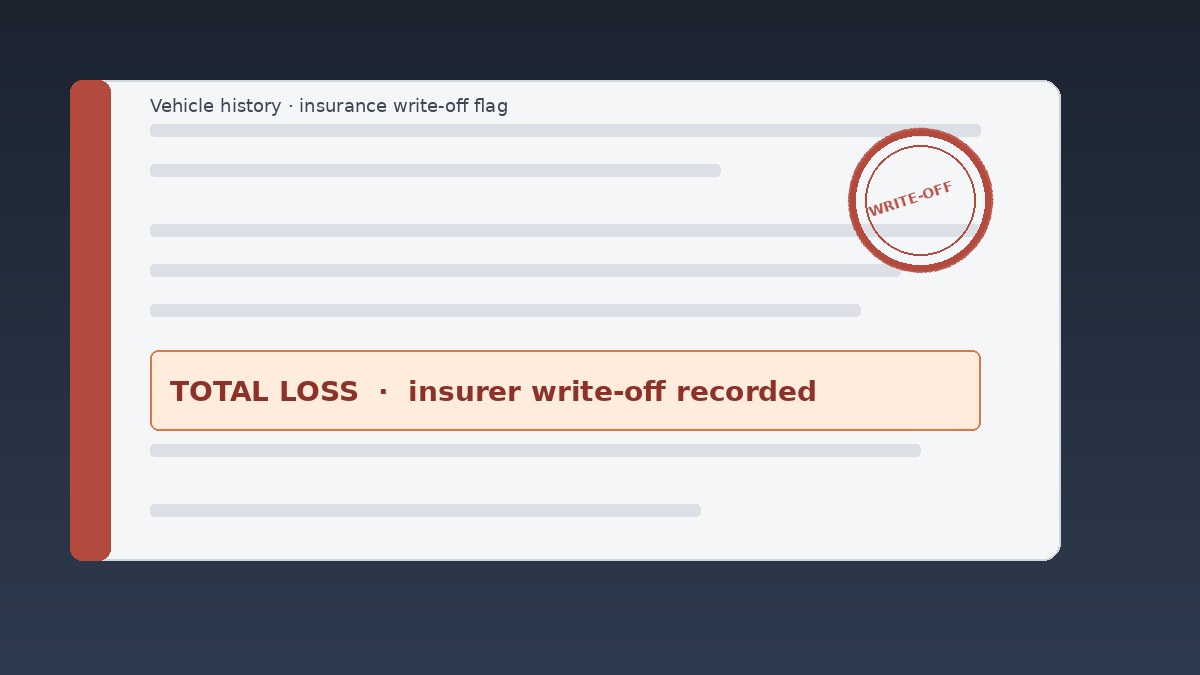
Seller says the title is clean — “it’s just a total loss flag on the CARFAX.” You’re supposed to treat that like a typo and keep talking price.
Look: that line is an insurance write-off signal, not a soft badge. We’ve pulled reports where “total loss” shows up and the title section still looks oddly quiet, and the opposite too — salvage or rebuilt stamped with no “total loss” wording at all. Same VIN family. Different paperwork paths.
Still in late September 2026, a single retail CARFAX usually lands around $39.99–$44.99 depending on which checkout you hit (sources still disagree — confirm before you argue pennies). Guest checkout here is $5.50 for the same official document; members pay about $4.50. Paying less doesn’t invent a write-off. Paying retail doesn’t scrub one either.
What “total loss” usually means on a CARFAX
In plain English: an insurer decided repairing the car cost more than it was worth — or close enough that they wrote it off against actual cash value. That’s an economic call. It’s not a mechanic’s essay about every welded seam.
Here’s the catch. Total loss is not automatically the same thing as a salvage or rebuilt title brand. Brands are state title stamps. The write-off flag is insurance history that fed into the report. They overlap a lot. They are not twins.
Honestly, if the seller only wants to argue about the three words and won’t open the title history section with you, that is already an answer.
Total loss vs salvage, rebuilt, accident, structural
People mash these together in Facebook comments. Don’t.
- Total loss = insurer write-off / uneconomical-to-repair decision in the history feed.
- Salvage / rebuilt = title brands. Salvage is the “this car was totaled for road use” stamp; rebuilt is what comes after repairs and a state inspection say it’s registerable again. See rebuilt title on a CARFAX.
- Accident reported is a crash record breadcrumb — police or insurance filing — not automatically a write-off. Details live under the row (accident reported on a CARFAX).
- Structural damage is about where the hit landed on frame/unibody parts — a different severity conversation (structural damage on a CARFAX).
So you can see total loss without salvage/rebuilt if branding lagged, the state rules differ, or data is incomplete. You can also see salvage/rebuilt without the words “total loss.” Read both sections. Don’t let the seller pick which one counts.
Seller PDFs and the “clean title” shrug
We’ve seen sellers email screenshots that stop before the ugly insurance row, or wave a months-old PDF like it aged into a clean bill of health. A cropped phone pic is not a fresh pull on the VIN stamped on the dash and door jamb.
Blunt risk: if you wire money off a seller PDF while “total loss” is sitting in the chat thread, you’re gambling that no brand, flood note, or later claim is waiting in the live feed. Pull your own. How we check authenticity is in how to verify a real CARFAX or AutoCheck PDF.
What to do before you hand over money
Don’t stop at the flag. Walk the document.
- Open the title history section — look hard for salvage, rebuilt, junk, flood, or reconstructed language
- Match dates around the write-off to later service, body-shop, or auction notes
- Ask for repair invoices with dates that line up (cash “cousin fixed it” stories are free; panel gaps aren’t)
- Get a pre-purchase inspection on a lift — not a driveway glance with the hood up
- If brands look weird or incomplete, check NMVTIS / state title data too
- Don’t wire money on a seller PDF alone
A “clean” sounding pitch next to a total-loss flag is common. Clean talk is cheap. Title brands and insurance rows are not.
How we treat it on our side
Run your own report — not theirs. Match the VIN on the car. Read total loss next to title brands, then decide if the price still makes sense after a real shop looks underneath. If the seller blocks that, walk. No essay needed.
For the whole-document triage order, see how to read a CARFAX report. And remember the opposite problem: plenty of ugly history never shows — covered in what CARFAX doesn’t show.
We’re a licensed reseller of official CARFAX and AutoCheck reports — not affiliated with CARFAX, AutoCheck, or Experian. If you need one VIN without a subscription trap, start at cheapcarfaxautocheck.com; guest checkout is still about $5.50 as of this writing (confirm at checkout if the page moved).


Comments (0)
No comments yet. Be the first to share your thoughts!
Log in to leave a comment.