
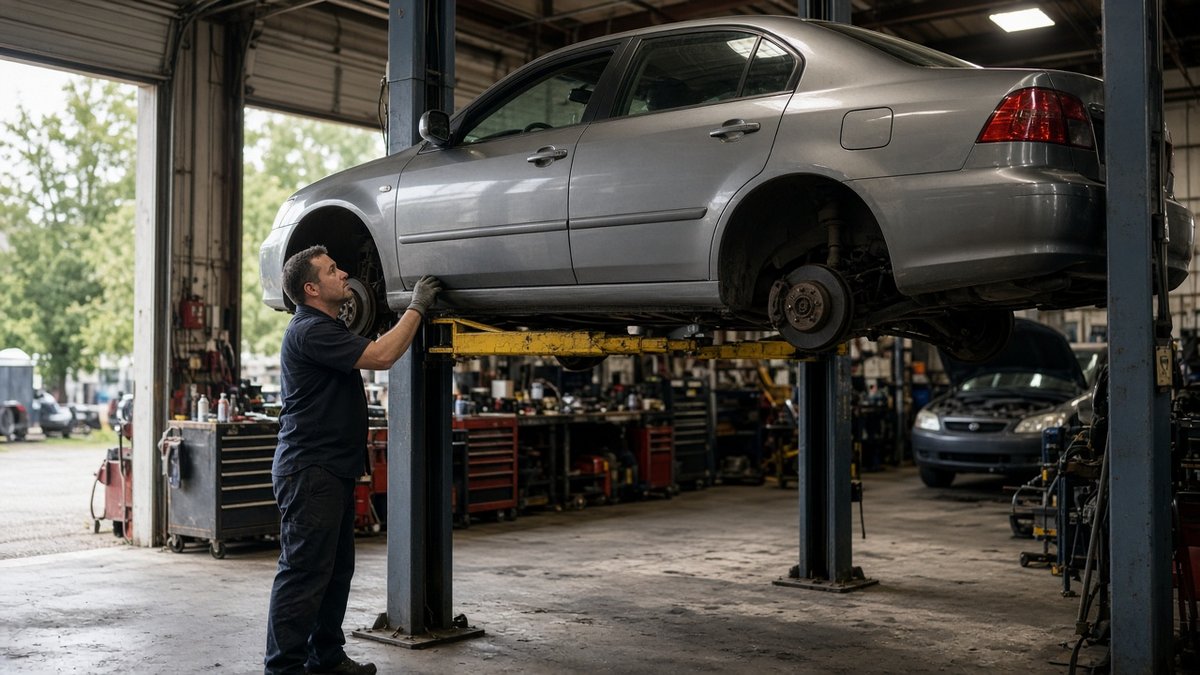
CARFAX shows a CV axle replacement only when the shop that did the job shares its service records, so plenty of axle swaps never appear on the report at all. When one does show up, it's usually a minor wear repair, but the mileage, the side of the car, and what else was replaced that same day tell you whether it was routine or part of something bigger.
We're writing this in early October 2026, after a run of questions from people who spotted a line like "front axle shaft replaced" on a report and weren't sure whether to walk. Honestly, most of the time you shouldn't. A constant-velocity (CV) axle carries power from the transmission to a front wheel on most front-wheel-drive cars, and to the wheels on many all-wheel-drive setups. The rubber boot that keeps grease inside the joint cracks with age, grit gets in, and the joint starts clicking. That's normal wear on a car with real miles. It gets more interesting when the axle shows up next to other repairs, which we'll get to.
How an axle job reaches the report
An axle replacement gets onto CARFAX through the same service-record feed that carries oil changes and brake work. The CARFAX vehicle history report page lists service history as its own section alongside accidents, title brands, and odometer readings. Dealers and big chains that report data tend to send a short entry with a date, mileage, and a description such as "CV axle assembly replaced" or "front drive shaft replaced." A lot of independent shops don't report anything, and a driveway DIY job never reports. So if the report is blank on axles, that tells you nothing either way. You still have to look at the car.
What a single axle line usually means
One axle replaced somewhere past 80,000 miles, with nothing else around it, is about as boring as a service record gets. Shops rarely reboot a damaged joint anymore. RepairPal's CV axle estimate says it recommends new replacement shafts because the cost of a boot repair is nearly as much as a new axle and there's no guarantee the joint isn't already damaged. That's why you see "replaced" on reports instead of "repaired." RepairPal also notes a failing axle is sometimes noticed during other repairs or inspections, so an axle line next to a tire or alignment visit can just mean a tech saw a torn boot on the lift.
Money-wise, the numbers online disagree a lot. AutoZone's CV joint cost guide puts aftermarket shafts around $60 to $150 each with roughly 1.5 to 3 hours of labor, while RepairPal's national estimate runs far higher, around $1,283 to $1,381 for its sample. Your car, OEM versus aftermarket parts, and local labor rates swing it. So treat any figure as a range and get a quote for that exact vehicle.
Patterns that make us look harder
Both front axles replaced at the same visit, especially along with a wheel bearing, tie rod, control arm, or alignment, can point to a curb strike or a pothole hit, or a front-end impact that never got filed as an accident. We've seen sellers wave this off as "just maintenance." It might be. But a cluster of suspension parts on one corner within a few months is worth asking about, and it's worth a look at whether the report shows any damage event near that date. Repeated axle replacements on the same side within a year or two can also mean a cheap part, a lift kit or lowering job that changed the axle angles, or a shop that kept guessing at a noise it never found.
On all-wheel-drive cars, rear axle or driveshaft work showing up next to transmission fluid service or differential work deserves a quick question about towing, mismatched tires, or launch-heavy driving. On a manual car, axle and clutch replacement lines close together can be a sign somebody drove it hard. None of this is proof. It's a reason to ask the seller for the invoice and to get the car on a lift.
How to check the car yourself
The report can't tell you how the axle is doing today, so check it in person. AutoZone's guide lists popping or clicking noises when turning as a tell-tale sign, and that's the easiest test you can do. Find an empty lot, turn the wheel to full lock, and accelerate gently in a circle both directions with the windows down. If it clicks in one direction and not the other, note which, and let a mechanic confirm which joint it is. Then look behind each front wheel with a flashlight for torn boots or grease slung across the inside of the wheel and suspension. A clunk when shifting from drive to reverse, or vibration under acceleration that goes away when you coast, is another thing to mention to the inspector.
If you're paying for a pre-purchase inspection anyway (the same lift time where shops catch the worn pads we cover in our brake replacement guide), ask the shop to note boot condition on all axles. It takes them a minute with the car already in the air, and it gives you a number to negotiate with if the boots are cracked.
When the report itself is the problem
The blunt risk here has nothing to do with axles. We still see sellers hand over a PDF "CARFAX" that's been edited or is from a different VIN, and service lines are easy to fake because nobody memorizes them. Match the VIN on the report to the windshield plate and door sticker, and if anything looks off, read our guide to spotting a fake CARFAX report. Pulling your own copy is cheap. We're a licensed CARFAX and AutoCheck reseller (not affiliated with CARFAX, AutoCheck, or Experian), and as of this month a single report runs about $5.50 as a guest or about $4.50 for members, with a CARFAX plus AutoCheck bundle around $6.75. Retail on the official sites is often around $39.99 to $44.99. Confirm the current price at checkout, since it does move.
So look, a CV axle line on a report is mostly a sign the car got normal maintenance from a shop that reports its work. Read the dates and the neighboring repairs, do the parking-lot circle test, and get the boots checked on a lift before you hand over money.
Comments (0)
No comments yet. Be the first to share your thoughts!
Log in to leave a comment.