
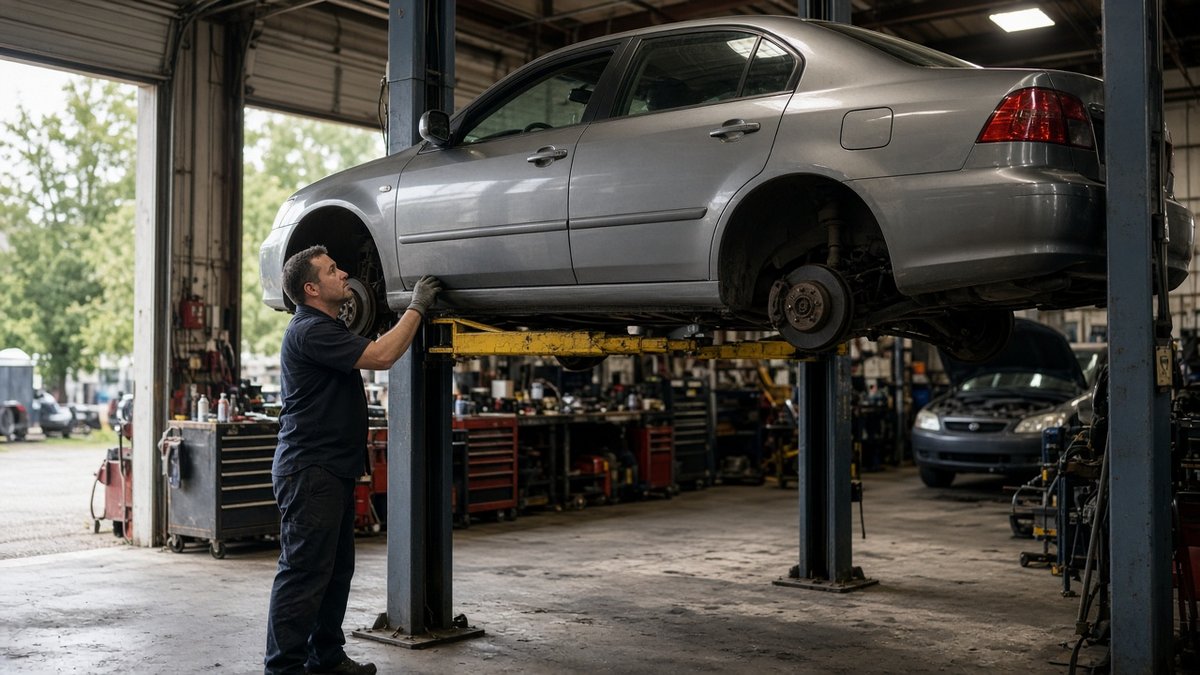
CARFAX shows a brake job only when the shop that did it sends service records to CARFAX, and the entry tells you a visit happened and nothing about how much pad is left or which parts went on. Driveway brake jobs and non-reporting shops leave the history blank. Pads are a wear item, so a 70,000-mile car with zero brake lines has either had brakes done somewhere quiet or is running on tired originals. You settle that at the wheel with a flashlight and a test drive, and the report helps you ask better questions.
Where brakes show up on a CARFAX report
Brakes show up on CARFAX as service history, and only one brake item gets named outright. When we checked the CARFAX vehicle history reports page on October 7, 2026, its Service History list read Oil Changes, Tire Rotations, Open Recalls, Brake Rotor Replacement, Transmission Replacement, and Safety Inspections. Pads, calipers, hoses, and fluid get no line of their own there. CARFAX Canada's support page says service record details on a report may vary, and that CARFAX can't add or revise those records because the individual service facilities own them. Our guide to reading service records shows how short those rows get.
A missing brake job proves very little
No brake entry usually means nobody reported one, and that happens all the time. Pads and rotors are a common do-it-yourself job, and Engineering Explained walks through a full pad and rotor swap on a Honda S2000 using a portable QuickJack lift. CARFAX Canada's FAQ says that if a car wasn't serviced at a facility it gets data from, you should ask the seller for the service records. So ask. The same blind spot hits oil changes on CARFAX and tire replacements, and a seller who did their own brakes may still have parts receipts.
Mileage tells you when to expect a brake job. AAA says brakes should be replaced about every 30,000 miles on average, depending on the car, how you drive, and the weather. Consumer Reports' maintenance guide gives 25,000 to 50,000 miles for pads and rotors and says to have them inspected at every oil change. Highway miles stretch that and city traffic shortens it, so use those numbers to decide when to look closely.
What a brake line on the report does and doesn't tell you
A brake record proves a shop touched the car on that date, and that's about it. Consumer Reports pointed out that federal standards cover brake systems on new vehicles while no government regulations cover replacement brake pads, and that the cheapest brake job may compromise safety. CR's current guide recommends replacing rotors and pads together, and its chief mechanic John Ibbotson says poor-quality parts can hurt braking performance. A report line won't tell you which kind of job you got. Ask for the invoice and look for brand names and whether rotors were replaced or skipped.
Repeat brake visits close together deserve a question too. ChrisFix's video on uneven brake wear explains that caliper guide pins that don't move freely can make pads wear unevenly and early. Two pad jobs on the same axle within a year could be a sticking caliper, a heavy towing life, or just a shop that upsells. Our post on what CARFAX says about mechanical problems covers reading patterns like that without overreacting.
Feel and hear the brakes on the test drive
The test drive tells you more about brakes than any report. AAA lists a high pitch or grinding noise from the built-in wear indicator, a vibrating pedal that points to warped rotors, a low or spongy pedal, longer stops, a burning smell, and an ABS light on the dash. CR adds the car pulling to one side under braking, and says grinding means replacement is overdue and the pads may be damaging the rotors. Car and Driver says pads should be replaced at their service limit, usually about 0.1 inch, and that some cars show a dash message from a pad sensor. If the ABS lamp is lit on a car from a storm area, read our post on the ABS light after a flood before you believe the cheap sensor story.
Look under the car before you sign anything. AAA says brake fluid is clear-yellow and oily, and that leaks can come from brake lines, the master cylinder, or a caliper. On salt-belt and flood-area cars, rusty lines and corroded boosters are a different problem from worn pads, and we cover the difference in brake line rust vs flood corrosion, brake booster corrosion, and what CARFAX shows for rust.
Brake recalls do follow the VIN
Recalls are the one brake problem a VIN check catches reliably. Ford's recall 25V544 covers 499,129 vehicles, 2015 to 2018 Ford Edge SUVs and 2016 to 2018 Lincoln MKX models, whose rear brake hose may rupture and leak brake fluid. We read Ford's September 2025 Part 573 filing, and it says NHTSA opened an investigation on October 3, 2024, and that Ford knew of 64 warranty claims and 16 customer complaints by June 2025. The fix is free: dealers inspect the rear hoses, replace damaged ones, and readjust the rest, and remedy letters were planned for early April 2026. CBS News quoted Ford saying a leaking hose can mean more pedal travel and longer stops. Benzinga noted on X that the Edge recall was part of a round of Ford recalls covering more than 800,000 vehicles.
Ford's filing also says these vehicles weren't built in VIN order, so a dealer or Ford's hotline is the cleanest way to confirm one car. NHTSA's recall lookup tells you whether a specific vehicle still needs a recall repair. Our posts on open recalls on CARFAX and NHTSA vs CARFAX recall data explain how those two sources differ.
Price worn brakes into your offer
Worn brakes are a fair reason to knock money off. AAA's brake pad cost guide puts pads at $150 to $350 per axle, $300 to $700 for both axles, and $250 to $500 per axle with rotors, with about an hour of labor per axle. Kelley Blue Book says pads average around $150 per axle and can rise to about $300, and pads with rotors run $250 to $400 per axle. CR's guide lists $500 to $950 for pads and rotors. Those ranges disagree because shops, regions, and cars do, and KBB says a carbon-ceramic Mercedes-AMG brake job could pass $15,000. Get one written quote and use it in the offer.
Run the VIN before you trust the seller's copy
Honestly, a seller-printed report is a weak thing to lean on, because anyone can edit a PDF and drop in a brake line that never happened. Pull the report yourself and hold it up against our fake CARFAX checklist. A CARFAX report through us costs about $5.50 as a guest or $4.50 as a member, and the CARFAX and AutoCheck bundle about $6.75, compared with roughly $39.99 to $44.99 at retail, though you should confirm the price at checkout. We're a licensed reseller of CARFAX and AutoCheck reports and aren't affiliated with CARFAX, AutoCheck, or Experian. Once you have it, line up its service dates with the seller's receipts.
Before you buy, at the car
Look through the wheel spokes at the pad and the rotor edge, since a deep lip on the rotor rim means a lot of wear. Do three firm stops from moderate speed on an empty road and feel for shudder, pull, or a sinking pedal. Check the ground and the inside of each wheel for wet, oily spots. If the history is blank and the miles are high, have the pre-purchase inspection shop write down pad thickness on all four corners, and run the recall check before you hand over money.
Sources
- CARFAX, Vehicle History Reports (Service History incl. Brake Rotor Replacement)
- CARFAX Canada Support, Service records on my report
- CARFAX Canada Support, Odometer readings and service records FAQ
- Engineering Explained on YouTube, How to replace brake pads and rotors (2017)
- AAA, 11 ways to know you may need new brakes
- Consumer Reports, Guide to car maintenance (updated May 2026)
- Consumer Reports, Brake pads: what to look for (2012)
- ChrisFix on YouTube, How to fix uneven brake wear (2015)
- Car and Driver, When to replace your car's brake pads
- NHTSA recall acknowledgment 25V544, Ford Edge and Lincoln MKX rear brake hose
- NHTSA Part 573 report 25V544 (Sept 2025)
- CBS News, Ford recalls 500,000 vehicles over potential brake fluid leak (Aug 2025)
- Benzinga on X, Ford recalls topping 800,000 vehicles (Aug 2025)
- NHTSA, Check for recalls
- AAA, How much does it cost to replace brake pads
- Kelley Blue Book, Brake repair prices and cost estimates

Comments (0)
No comments yet. Be the first to share your thoughts!
Log in to leave a comment.