

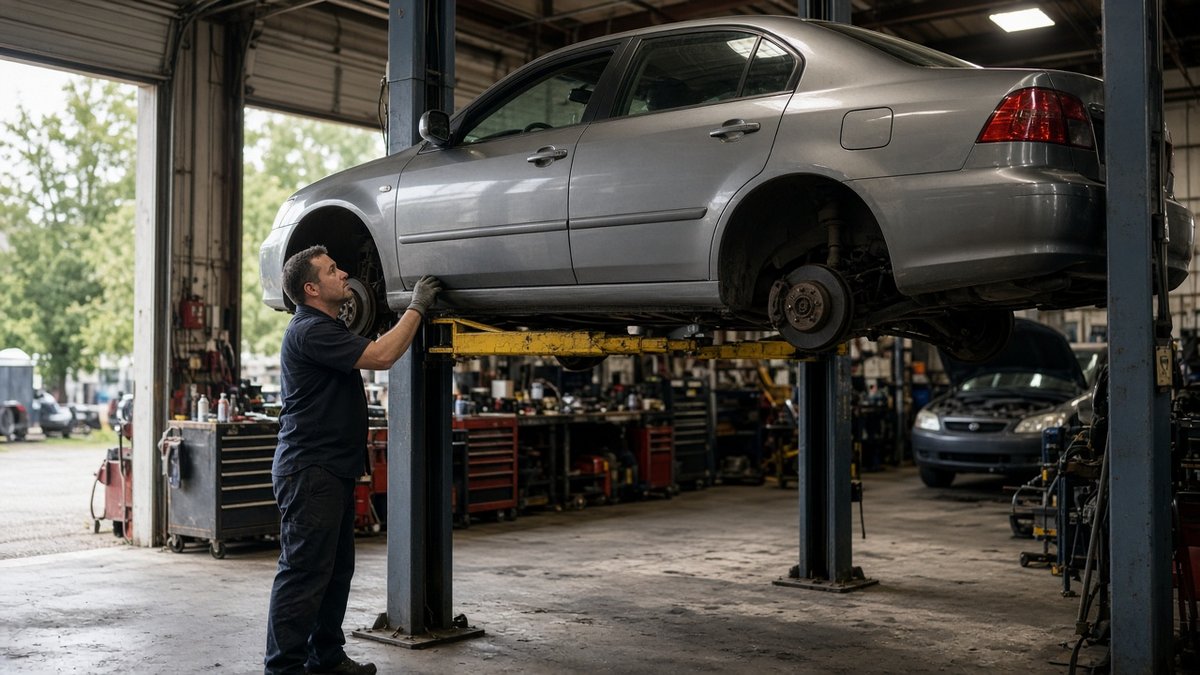
CARFAX shows rust only when somebody put it on the record, like a shop invoice for a rotted brake line, a frame-corrosion recall, or years of registrations in salt-belt states. Nobody grades the underbody to build the report, so a truck with flaking frame rails can come back with a clean, boring history. Use the report to learn where the car lived and what got fixed. Then get it on a lift, because the metal is the only thing that tells you how bad it is.
Why rust rarely gets its own line
Rust seldom becomes a report event, because it builds slowly and insurance usually won't pay for it. When we pulled the CARFAX vehicle history reports page and its glossary in early October 2026, neither page used the word rust or corrosion. The closest items were service history, safety inspections, states owned in, and flood titles. AAA's Auto Club Group said in a February 2026 warning that corrosion is considered normal wear and tear and usually isn't covered by insurance. A repair nobody claims rarely shows up as damage, which is one more thing on the list of what CARFAX doesn't show.
The bills are real anyway. AAA's de-icer fact sheet put salt rust repairs at more than $3 billion a year, about $490 per repair, with 15 percent of winter-region drivers needing one in five years. The AP added that liquid de-icers are even more corrosive than traditional salt. That survey dates to 2016, so treat $490 as an old average. See why winter salt rust goes missing.
Service and inspection rows are the closest hint
Shop records are where rust leaks onto a report, usually without the word itself. CARFAX lists service items like brake rotor replacement and safety inspections, and the glossary says comments vary with what each source sends. So a brake, exhaust, or suspension job on an older salt-state car is worth asking about. Inspection rows mostly prove mileage, since the glossary says that's where odometer readings get collected. Our guides to reading a CARFAX report and mechanical problems show where those rows sit.
Corrosion recalls do show up
A rust recall is the clearest formal corrosion record tied to a VIN. Honda's 2023 NHTSA filing recalled 563,711 2007 to 2011 CR-Vs sold or ever registered in 22 salt-belt states and D.C., because road salt could corrode the rear frame until the trailing arm fell off. It said there were no reports outside that region. In June 2026 Consumer Reports covered recall 26V365, over 880,000 Pilot, Passport, Ridgeline, and MDX models whose rear subframe paint could fail and rust, and CR posted it on X. Open recalls appear on CARFAX, but NHTSA says its VIN search skips repaired recalls and ones over 15 years old. See open recalls on CARFAX.
Some rust fights never become recalls. Autoweek reported in 2016 that a class-action settlement over 2005 to 2010 Tacoma, 2007 to 2008 Tundra, and 2005 to 2008 Sequoia frames that lacked adequate rustproofing could cost Toyota up to $3.4 billion. A settlement isn't a recall, so don't count on a recall row for it.
Read location history like a rust map
The state list is your best rust clue on the whole report. CARFAX shows the states a car was owned in, and its glossary defines a relocation as a move between states with no ownership change. Honda drew its CR-V recall from registration records, which tells you how much "ever registered in" matters. Five Ohio winters followed by a Florida title still means Ohio salt. See registration history on CARFAX and the salt-belt history checklist, plus state notes for Illinois and Michigan.
Flood rust and road-salt rust are different stories
Road salt attacks from underneath, while flood water leaves rust where it never belongs, like seat rails and dash screws. NMVTIS tracks brands like junk, salvage, and flood, notes that some states have no flood designation, and describes flooded cars trucked from Louisiana to the upper Midwest after Katrina. CR says CARFAX calculated 347,000 cars were flood-damaged in 2024 and tells you to look for rusted screws and a mold or mildew smell. CR's flooded-car video walks through spotting one before you drive off the lot. Compare undercarriage rust vs flood and the Great Lakes mix.
What an underbody check looks for
A lift inspection grades the rust that the report can't. CR's inspection guide says to check wheel wells, door bottoms, and blistered paint, notes heavy tailpipe rust may mean a new exhaust, and warns that fresh undercoating may hide structural repairs. CR's red-flags list quotes deputy auto editor Jon Linkov saying rust is hard to get rid of, and warns that a small visible spot can mean many hidden ones. CR prices a PPI at $100 to $150; our inspection cost guide puts it at $150 to $300. ChrisFix's inspection video is a decent primer, and the brake line rust guide covers lines.
A passed state inspection sets a low bar
State rules reject rust that weakens structure, which sets a minimum and says little about the rest of the car. Virginia rejects frames with rust holes or corrosion that weakens them, and New Hampshire rejects structural rust that affects safety. Maryland rejects frames rusted to substantially weaken them and floors with holes over 6 square inches. PennDOT's 2019 bulletin says there is no specific reject rule for exterior rust. The regulations name rust for floor pans rusted through, and frames fail when they aren't in solid condition. So a fresh sticker means the car cleared a minimum that day.
Deal-breaker or cosmetic
Rust on anything that holds the car together or stops it is a walk-away until a mechanic clears it. That means frame rails, subframe and suspension mounts, floors, brake lines, and fuel lines, and the AP noted brake line and fuel tank rust can be deadly. The CR-V and Pilot recalls both centered on rear suspension mounts. Surface rust on exhaust parts and brackets is a price issue, and CR calls some tailpipe rust normal. Rust alone doesn't brand a title either, per frame rust and branded titles, and real collision damage reads differently, as frame damage on CARFAX explains. Look, a seller who just sprayed thick black undercoating on a ten-year-old salt-state truck is asking you to trust paint over steel.
Negotiating with a rust report
Get the mechanic's findings in writing with repair costs, because CR says that report is what you negotiate with. Frame work is expensive. Autoweek said Tacoma frames ran $4,338 to $4,889 for the part, and a dealer said labor could push a replacement to $15,000 or more. Honestly, check the history yourself too, since a seller's PDF can be doctored, per spotting a fake CARFAX.
Pull the report yourself
Through us a CARFAX report runs about $5.50 as a guest or $4.50 as a member, and the CARFAX plus AutoCheck bundle is about $6.75, against roughly $39.99 to $44.99 retail, so confirm at checkout. We're a licensed CARFAX and AutoCheck reseller, not affiliated with CARFAX, AutoCheck, or Experian. You'll get the states, recalls, and service rows. The rust grade comes from the lift.
Sources
- CARFAX, Vehicle History Reports (service history, states owned in)
- CARFAX, Glossary (Inspections, Relocation, General Comments)
- AAA The Auto Club Group, Winter Road Salt Can Cause Hidden Vehicle Damage (February 2026)
- AAA, Road De-Icers and Rust Damage Fact Sheet (2017)
- AP News, AAA: Vehicle rust damage costs US drivers $3 billion a year (2017)
- NHTSA, Part 573 Safety Recall Report 23V-228, Honda CR-V rear frame corrosion (2023)
- Consumer Reports, Honda and Acura Recall SUVs and Trucks for Suspension Rust (June 2026)
- Consumer Reports on X, Honda and Acura suspension rust recall (June 10, 2026)
- NHTSA, Check for Recalls
- Autoweek, Toyota frame rust settlement could cost the company $3.4 billion (2016)
- NMVTIS, Consumer information (brands, flood vehicles)
- Consumer Reports, How to Avoid Hidden Damage on a Used Car
- Consumer Reports on YouTube, Flooded Cars: How to Spot One Before You Buy (2017)
- Consumer Reports, How to Inspect a Used Car to Avoid Costly Repairs
- Consumer Reports, Biggest Red Flags When Buying a Used Car
- ChrisFix on YouTube, How to Inspect a Used Car for Purchase (2016)
- Virginia Administrative Code 19VAC30-70-120, Frame
- Maryland COMAR 11.22.04.08, Vehicle Frame, Body, and Sheet Metal
- N.H. Admin. Code Saf-C 3221.06, Structural Rust (LII)
- PennDOT Vehicle Inspection Division Bulletin BI19-08, Rust Within the Regulations (December 2019)

Comments (0)
No comments yet. Be the first to share your thoughts!
Log in to leave a comment.