
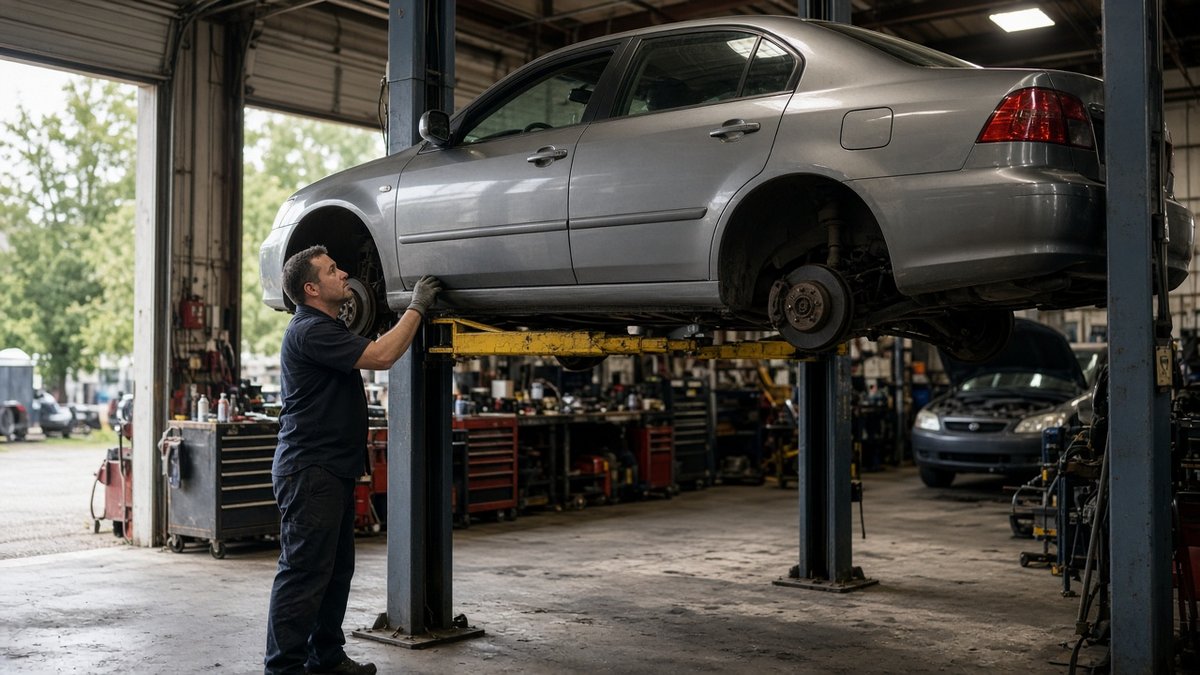
Suspension repair reaches a CARFAX report in fragments, usually as a vague service visit, a front-corner damage record, or an open recall, and almost never as a line that says new struts or a replaced ball joint. The report can't feel a bouncing nose, measure play in a joint, or read a toe angle. So a 90,000-mile SUV on its original shocks and one with a fresh front end can carry the same quiet history. The report tells you where to look, and the wheel well and a rough stretch of road tell you what you're buying.
CARFAX's own list skips the suspension
CARFAX names a handful of service items, and none of them is a suspension part. The CARFAX report page, as it read when we pulled it on October 7, 2026, puts six things under Service History, from oil changes and tire rotations to brake rotors, transmissions, open recalls, and safety inspections. Shocks, struts, control arms, ball joints, and alignments aren't on it. CARFAX Canada's FAQ gives sample service records like "wheels checked" and "maintenance inspection completed," which is about as specific as a suspension visit tends to get. Its support article on service records adds that records aren't available for every VIN and that CARFAX can't add or revise them, because the shops own them. Reading CARFAX service records covers how thin those rows get.
Three side doors where suspension trouble shows up
A damage record is the likeliest place a bent suspension part leaves a trace. The same CARFAX page says reports check damage location and point of impact, records of damage repair, and structural damage. A front-corner hit is exactly where control arms, tie rods, and struts live, so read a minor accident on CARFAX as a reason to inspect that corner, and treat a structural damage line much more seriously. Consumer Reports says insurance may cover hard parts such as suspension components after a pothole, so a claim can create a record if the insurer or body shop shares data. A repair paid in cash usually leaves nothing, which is the same blind spot we cover in accidents that never reach CARFAX. Recalls are the third, covered below.
Potholes and curbs cause damage nobody writes down
Most suspension damage comes from roads, and most of it never touches an insurer. In its pothole survival guide, Consumer Reports quotes Mike Crossen, lead technician at its Auto Test Center, saying steering and suspension parts can be damaged, bent, or become loose, that alignment might be off, and that subframes can even be damaged. AAA East Central says about one in ten drivers had pothole damage serious enough to need a repair, at an average of almost $600, and puts repairs anywhere from $250 to as much as $1,000, from tire punctures and bent wheels up to suspension damage. This year started badly too. AAA Northeast warned in March 2026 that pothole season arrived early after a snowy winter, and cited an AAA survey estimating 44 million U.S. drivers got pothole repair bills in 2022.
Shocks and struts wear out on a schedule the report ignores
Dampers are wear parts, so mileage tells you more than a blank history. Kelley Blue Book says shocks and struts typically last 50,000 to 100,000 miles, and lists the signs its maintenance expert Gary Hardesty watches for: a bouncing car, leaning in sharp turns or tipping when you brake, fluid leaking behind the tires, clunking over bumps, and cupped tires. Consumer Reports' maintenance guide says rough roads wear them out faster and that worn struts and shocks can lead to unsafe braking and handling. So a car past 80,000 miles with zero suspension work on record has either had it done somewhere quiet or is still on tired originals. Brake jobs have the same reporting gap, as our post on brake replacement on CARFAX explains, and what CARFAX says about mechanical problems covers the bigger picture.
Ford's 2026 ball joint recall shows why the VIN check matters
Recalls are where a VIN check catches suspension danger reliably. Ford's recall 26V340 covers 4,653 vehicles, 2021 to 2026 Bronco Sport and 2022 to 2026 Maverick, whose front lower control arm ball joints may have been incorrectly installed or repaired at the plant, letting the arm separate from the knuckle. We read Ford's May 2026 Part 573 report, and under warning signs it says "None." The first claim it describes was a 2025 Bronco Sport whose left front wheel became misaligned at one month in service. Owners were told not to drive, and Ford says dealers will tow the vehicle for free or, where available, inspect it at the owner's location. Car and Driver, USA Today, and NBC DFW on X all covered the order in early June.
Some suspension recalls do give a warning. Ford's recall 25V341 for 29,501 F-150 Lightning trucks says a loose upper ball joint nut can cause vibration and a clunk or rattle as the suspension moves. Run every VIN through NHTSA's recall lookup before a test drive, then compare what an open recall on CARFAX looks like and how NHTSA and CARFAX recall data differ. Honestly, if a Do Not Drive VIN shows up driving to meet you, walk until a dealer signs off.
An alignment row is a hint about bigger work
An alignment on the record often means somebody touched the suspension or the tires. KBB's wheel alignment guide says a curb or pothole can knock a car out of alignment instantly, that the signs are drifting, heavy steering, and a shaking wheel, and that lane-keeping and adaptive cruise depend on accurate wheel position. Consumer Reports says to get an alignment when you buy tires or have suspension parts replaced. So if an alignment sits right after a damage record, ask what got replaced and see the invoice. If it sits next to new tires, our post on tire replacement on CARFAX covers reading wear patterns.
What suspension work costs when the history is blank
A quiet report on a high-mile car should show up in your offer. Hardesty told KBB that a Toyota Camry strut job runs up to two hours of labor with struts at about $300 a pair, and that most jobs land under $1,000. He also said active suspensions on luxury models can run $1,500 to $2,600 plus labor and calibration, and that struts should be replaced in pairs. KBB puts an alignment at $100 to $200, with a dealer average of $183. Shops and regions vary, so get a written quote, usually from the pre-purchase inspection, and bring it to the seller.
The report costs less than one strut
Look, a seller-printed report proves very little, since anyone can edit a PDF, and our fake CARFAX checklist walks through the usual tricks. We sell CARFAX reports for roughly $5.50 to guests and $4.50 to members, with a CARFAX and AutoCheck pair for around $6.75, while retail usually sits between $39.99 and $44.99, and the checkout page has the final number. We hold a reseller license for both brands and have no affiliation with CARFAX, AutoCheck, or Experian. Read the damage locations first, then the service dates, then the recall section.
On the lift and on a bad road
Look behind each tire for oily shock bodies and run a hand across the tread for cupping. ChrisFix has a video on checking your own suspension for worn ball joints, sway bar end links, bushings, and tie rods, and a separate one on spotting a bad ball joint on upper and lower control arms. Drive over a broken road with the radio off and listen for clunks, then notice on a level straight whether the car tracks true or drifts. If any corner had reported damage, have the shop check that corner's arms and alignment numbers before you pay.
Sources
- CARFAX, Vehicle History Reports (Service History and Accident Data lists)
- CARFAX Canada Support, Odometer readings and service records FAQ
- CARFAX Canada Support, Service records on my report
- Consumer Reports, Will your car insurance pay for pothole damage
- Consumer Reports, Pothole survival guide
- AAA East Central, Potholes can be a black hole for your wallet
- AAA Northeast, Potholes pop up early this year (March 2026)
- Kelley Blue Book, Car shocks and struts: signs they are worn out
- Consumer Reports, Guide to car maintenance (updated May 2026)
- NHTSA recall acknowledgment 26V340, Bronco Sport and Maverick lower ball joints
- NHTSA Part 573 report 26V340 (May 2026)
- Ford, Do Not Drive advisory for certain Bronco Sport and Maverick vehicles
- Car and Driver, Bronco Sports and Mavericks hit with Do Not Drive warning
- USA Today, Ford's do not drive recall includes Bronco Sport, Maverick (June 2026)
- NBC DFW on X, Ford Do Not Drive order (June 2026)
- NHTSA Part 573 report 25V341, F-150 Lightning upper ball joint nut
- NHTSA, Check for recalls
- Kelley Blue Book, What is wheel alignment
- ChrisFix on YouTube, How to check out your own car's suspension system (2013)
- ChrisFix on YouTube, How to check if a ball joint is bad (2014)

Comments (0)
No comments yet. Be the first to share your thoughts!
Log in to leave a comment.