
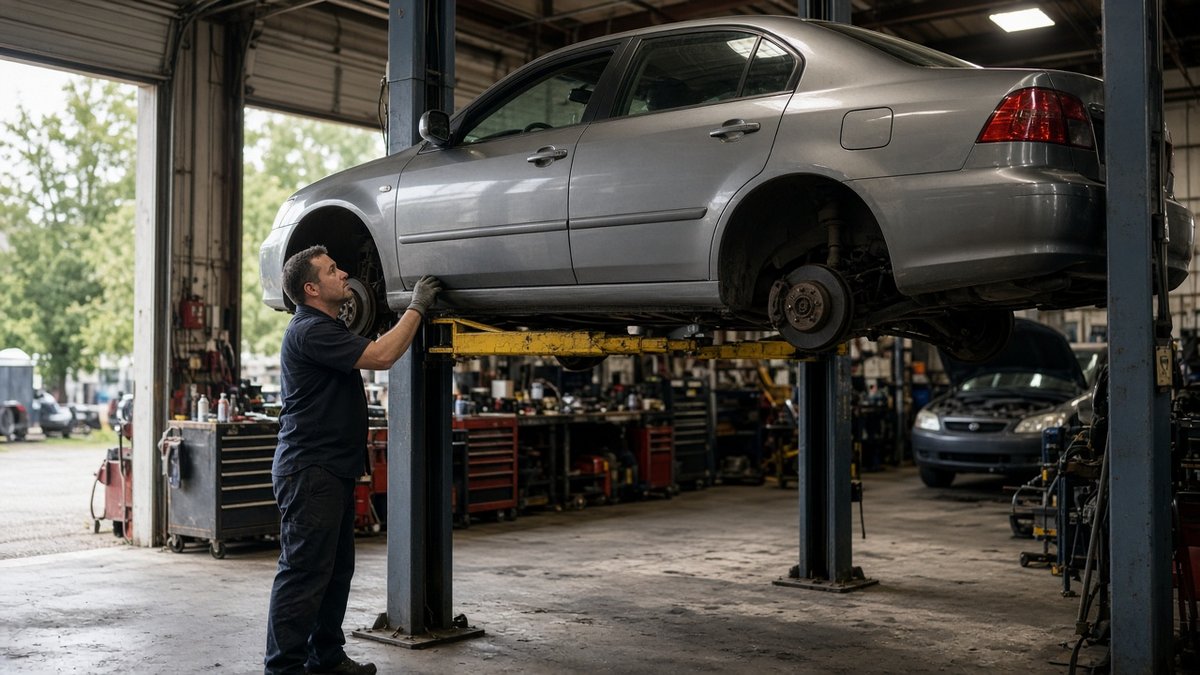
When a used car drifts toward the shoulder, chews the inside edge of a front tire, or gets pitched as "just needs an alignment," CARFAX will not prove the geometry was fixed. Wheel alignment — camber, caster, and toe — reaches a report only if a reporting shop logged that job, and the brand's own Service History marketing samples highlight oil changes, tire rotations, brake rotors, transmissions, inspections, and recalls, not a dedicated alignment line.
Look, early October 2026 we still see sellers wave a tidy PDF after a hard pothole season and treat blank history like proof the rack is square. We've read quiet reports on cars that needed a four-wheel setup before the next tire set survived. Cash shops and driveway shrugs leave zero footprint. This post is about wheel and tire geometry on a history report — not body-panel gaps, and not the same question as whether suspension parts show on CARFAX.
What CARFAX actually samples under Service History
The CARFAX vehicle history reports page, as we pulled it on October 8, 2026, lists six Service History examples: Oil Changes, Tire Rotations, Open Recalls, Brake Rotor Replacement, Transmission Replacement, and Safety Inspections. Alignment is not on that list. That does not mean an alignment never appears. It means the marketing samples do not promise a structured "wheel alignment" field the way they showcase oil and rotors.
CARFAX Canada's service-history explainer is more explicit: available records can include oil and filter changes, alignment checks, and more. Its support article on service records shows soft rows like "vehicle serviced," "wheels checked," and "tires rotated," and notes that records are not available for every VIN and that CARFAX cannot rewrite shop-owned data. When alignment does print, you often get a short visit, not degrees of toe. Reading CARFAX service records covers how thin those lines stay.
Alignment is geometry, not a new strut
Wheel alignment sets three angles. Camber is the inward or outward tilt of the tire from the front. Caster is the forward or rearward tilt of the steering axis. Toe is whether the fronts of the tires point in or out from above. Sabin Civil Engineering's explainer on camber, caster, and toe is a clean visual. AAA's Via piece with David Bennett puts the same three adjustments on a shop lift and notes that toe is the one shops make most often.
That is different from replacing control arms, ball joints, or struts. Parts work can force an alignment afterward, and a bent part can make the angles impossible to hit, but alignment itself is the measurement step. Consumer Reports says you should align when you buy tires or replace suspension parts, which is why a silent report next to brand-new rubber is a yellow flag. Stay on the suspension post for parts; stay here for rack work.
Where alignment clues sneak onto a report anyway
Three side doors matter. A reporting shop can log an explicit alignment or a vague undercarriage or tire visit. Open recalls tied to toe or camber hardware can follow the VIN even when routine service is quiet. Accident rows point at the corner that took the hit — where geometry usually dies.
NHTSA campaign 25V605 covers a tiny batch of 2025 Hyundai IONIQ 5 vehicles where rear toe and camber adjustment bolts may have been under-torqued during assembly. The Part 573 filing says a system error at the alignment stage cut tightening torque, and the remedy includes bolt replacement, wheel alignment, and tire replacement if needed. Kelley's coverage by Sean Tucker (September 25, 2025) repeats the free-dealer fix and rattling-noise warning. Eight units is tiny, but it is a real geometry-adjacent recall on the public record.
The same CARFAX marketing page that skips alignment under Service History still sells Accident History with damage location, point of impact, damage repair records, and structural damage. A front-corner scrape or curb kiss is reason to demand an alignment printout and a tire check. Pair that with our notes on a minor accident on CARFAX and structural damage lines before you buy the "just pulls a little" story.
What blank history actually costs you
Money shows up twice: the alignment you may pay after the sale, and the tires you replace early when geometry was wrong for months. RepairPal (estimates updated September 3, 2026) puts a typical alignment around $186–$273 in labor. KBB quotes many front-end jobs closer to $65–$100 and lifetime packages near $200. Sources disagree, so treat the numbers as ranges and confirm at the shop counter.
RepairPal also warns that after a collision, large pothole, or curb hit, the angles may not adjust into spec until bent parts are replaced — sometimes that means chassis work. AAA's pothole guidance is blunt: hard impact can knock wheels out of alignment, mess with steering, damage a tire or wheel, or bend suspension parts, and you should have alignment checked if the car pulls left or right. NHTSA's September 9, 2026 note on hazard braking and steering is the driving side of that same story; the follow-up inspection after you dodge the crater is on you, not on the PDF.
Honestly, a fake "full Carfax" JPEG from a seller folder is a worse trap than a real report with thin service. We are a licensed CARFAX and AutoCheck reseller, not affiliated with CARFAX, AutoCheck, or Experian. Guest reports often land near $5.50, members near $4.50, and a bundle near $6.75, while retail single reports still float around $39.99–$44.99 depending on the channel — confirm at checkout because those stickers move. None of those prices buy you camber degrees the shop never uploaded.
How to shop when the seller says "just an alignment"
Drive on a straight, flat road with light hands and note which way it wanders. Park and look at the front tires for inner-edge feathering or a shoulder chewed compared with the center. Ask for the alignment printout with before-and-after specs, not a verbal promise. If a damage record sits near a service visit, ask what parts were replaced before the rack work — our posts on tire replacement on CARFAX and brake jobs help you read neighboring wear items.
Then get a pre-purchase inspection that includes an alignment rack or at least a printed measurement. History reports catch reported events; they do not measure toe. Oil-change density can look healthy while geometry stays ignored — see oil changes on CARFAX — and broader mechanical silence is covered in mechanical problems on CARFAX. Adjacent service gaps we have already mapped include 12V battery rows, alternator replacements, and A/C compressor work. Use those for neighboring questions; do not treat a clean climate or charging history as proof the car tracks straight.
Sources
- CARFAX Vehicle History Reports — Service History sample list
- CARFAX Canada — what service records mean
- CARFAX Canada — service history can include alignment checks
- RepairPal — wheel alignment cost estimate
- Kelley Blue Book — wheel alignment prices and signs
- KBB news — Hyundai Ioniq 5 toe/camber bolt recall
- NHTSA Part 573 — recall 25V605
- Consumer Reports — align when buying tires or replacing suspension
- AAA Via — alignment vs balance (camber, caster, toe)
- AAA — pothole damage and alignment check
- YouTube — Sabin Civil Engineering, Understanding Wheel Alignment
- X — @NHTSAgov on debris, braking, and controlled steering
Comments (0)
No comments yet. Be the first to share your thoughts!
Log in to leave a comment.